

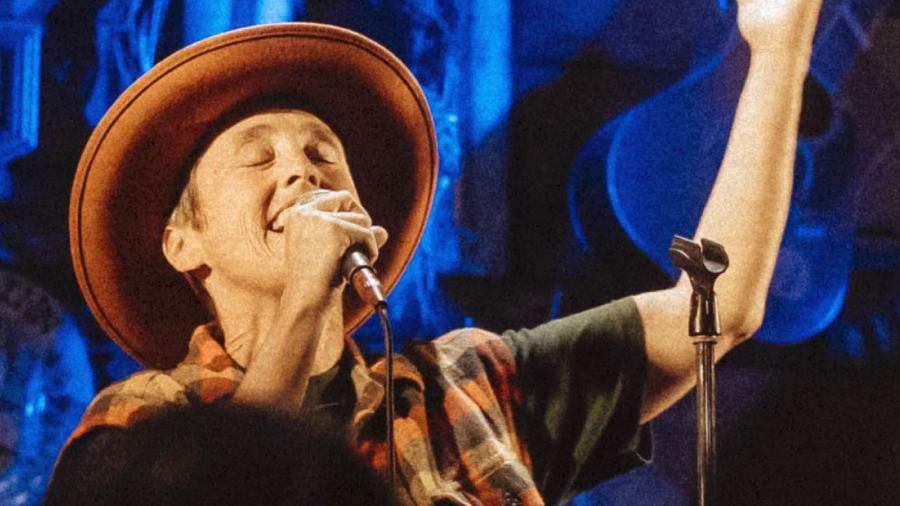
Kia ora, Redwood, and welcome to the show. For those who may not be familiar with you, could you introduce yourself and share a little about who you are and what you do?
Kia ora. I'm Redwood Ryder. I'm a spoken word poet. I'm originally from California and a long-term import to Aotearoa, based in Mohua, Golden Bay.
Wonderful. So what first drew you to poetry and spoken word as your form of expression?
I probably started writing poems when I was a child. It was a way of expressing myself. I didn't always feel resonant with the human world, so I'd go off into my own world and write poems. Then, in my early 20s, I got into the slam poetry scene in California. I’d just gotten out of university, where I’d been surrounded by this very erudite concept of poetry, full of big words I didn’t even understand. I sort of tailed off from my poetry practice when I was exposed to that.
But when I found the spoken word scene, it really ignited something in me. Slam poetry is a competition where people are judged on stage, and I think I'm a little too sensitive for that, but the dynamic of it forced connection with the audience. Poets from all different cultural backgrounds were breathing fire out of their experiences. The more real you were, the more people landed with you. That ignited something in me that's lasted for years.
Was there a moment that really set you firmly on this path?
Yeah, I’ve always had many projects in my life, but one moment that really made me go, “This is what I must do,” was during my master's in environmental science. I was idealistic from an early age, thinking someone might know the answers to the world's problems, or that we could figure them out together.
But in grad school, even surrounded by amazing professors, no one had one answer. There were more questions. During that time, I performed poems at school talent shows and got hundreds of my fellow students cheering for me. They selected me as one of the graduation speakers because I promised to do a poem.
I wrote a poem for my master’s graduation. Looking back, the rhymes were probably embarrassing, but there was one line I remember: “We have to lean on each other to grow mental endurance. My true employer is the earth, even if it doesn’t offer dental insurance.” I still don’t have dental insurance.
Seeing all these hundreds of peers looking back at me, shining their eyes with gratitude, I felt like I’d landed and connected with such a big group. That moment made me realise, “Oh, this is really necessary. We need poetry that connects us back, and I have a role here.” So, funny story: I went to get a master’s in environmental science and found out I needed to be a poet. Long story, but good ending.
A lot of your poems seem rooted in the land, ecology, and community. Is that where the inspiration comes from?
Yeah, a lot of it. I often write when I’m in nature. Even in my most recent album, Changing My Mind, it’s not all about the natural world, but every poem has some nature metaphor. Nature is a language for me. Tree roots remind me how we’re connected, what sustains us; the ocean connects to emotion, to being part of something vast. Nature imagery helps me get closer to what we are.
Would you see your work as a dialogue between the natural world and people?
Yeah, there’s always a dialogue. I’m more like a translator or messenger, helping the connection be clear, helping us listen.
And your work blends art and activism a lot. How do these two strands come together for you?
I’m an activist, and it can be really hard to fight for things in the world. A lot of activists are low-paid or volunteering while fighting against well-organized corporate or political forces. Poetry has been a way to keep going. It helps people recognize their own power and keep believing that social change is possible. Reaching people through poetry gently touches hearts, finds openings when the news makes us want to shut down. That’s been a natural thing for me over time, whether writing poems for causes or creating albums like Sacred Activist, inspired by Andrew Harvey’s term “sacred activism.” Activism can be a spiritual practice; it’s sacred work, and we need to feed our spirits to keep going.
Do you see your poetry as protest, prayer, or both?
Both. Non-binary. The protest is often a prayer, and the prayer is often a protest.
I understand you once performed a poem at Te Papa challenging government policy. What role does risk play in your activism?
That was a singular, interesting moment. I was on a panel with the Parliamentary Commissioner for the Environment, and I was extremely opposed to a policy on 1080 poison. I got on stage and did a ten-minute poem directly challenging the figure, in front of an audience.
I had people coming up to me afterwards, thanking me. It ignited something because we so rarely get the chance to tell politicians what we think and have them actually listen. Risk is important—when one voice ignites, it inspires others. We’re all candles; when one voice risks, it can light others.
Do you think delivering it as poetry gave it more gravity than just stating your opinion?
Totally. Often in activism, our audience isn’t the person we’re confronting; it’s all the people who watch and take the message away. Speaking truth through poetry reaches people in a different way.
You’ve released several albums. How do they reflect different stages of your journey?
I’ve released five albums, two live, three studio, all in collaboration with musicians. Music gives the poems space to breathe. Each album has different musical and thematic inspirations. My most recent, Changing My Mind, is about healing and reconnecting with ourselves. I went through chronic illness, retrained my nervous system, and became a craniosacral therapist and meditation teacher. That album reflects all of that: healing, belonging, gratitude, and love.
How do you get your poetry out into the world?
That’s the tricky part. Live performance is key. People see me perform and want to stay connected. Festivals, house concerts, open mics—they’re all important. Online sharing helps, but some things resonate unexpectedly, like the Te Papa poem. One day, I’d love to have a personal assistant to handle admin so I can focus on creating.
In a world saturated with digital noise, what does poetry offer that other forms of community participation can’t?
Live performance creates a co-creative container. People bring energy, which feeds me and feeds back to them. Poetry is spoken word before it’s written—it’s how we evolved to connect.
Any advice for stage-nervous poets?
It’s okay to be nervous. The key is being loyal to the fact that something beautiful wants to come through you. If fear wins, no one hears that medicine. We all have something to share.
Do you see poetry as a way to re-enchant or reconnect with something we’ve forgotten?
Absolutely. Poems are treasure maps. They help me remember what I’ve forgotten—and often, others need to hear the same things. They reconnect us with something we already know on a deeper level.
Where can listeners find your work?
Online, in most streaming services. Bandcamp is redwoodthepoet.bandcamp.com, which directly supports the work. I’m also posting snippets on Instagram. Every time I open up and have that connection touch people, it reminds me why I do this.
 Previous


